A tool trolley earns its keep the moment your tools need to move: between machines, across a warehouse floor, or out to a job site. Here’s what actually matters when choosing one, where ReadyRack’s trolley range fits, and how to think about mobile versus fixed storage across a bigger site.
What a tool trolley needs to do
Unlike fixed tool storage, a trolley has to survive being wheeled around all day, often on uneven concrete and often loaded well beyond what it looked like it was designed for. The things worth checking before you buy:
- Wheel quality. Castors that handle uneven concrete without seizing up. This is usually the first part of a cheap trolley to fail, well before the frame or drawers do.
- Load capacity. Buckets, tools and consumables add up fast; check what the trolley is actually rated to carry, not just what looks like it’ll fit.
- Configuration. Some trolleys are built specifically around bucket storage, others are more general-purpose with open shelves or drawers.
- Stability when loaded. A trolley that’s top-heavy once loaded is harder to manoeuvre and more likely to tip on uneven ground.
- Security. If the trolley moves between a workshop and a job site, a lockable option protects tools left unattended.
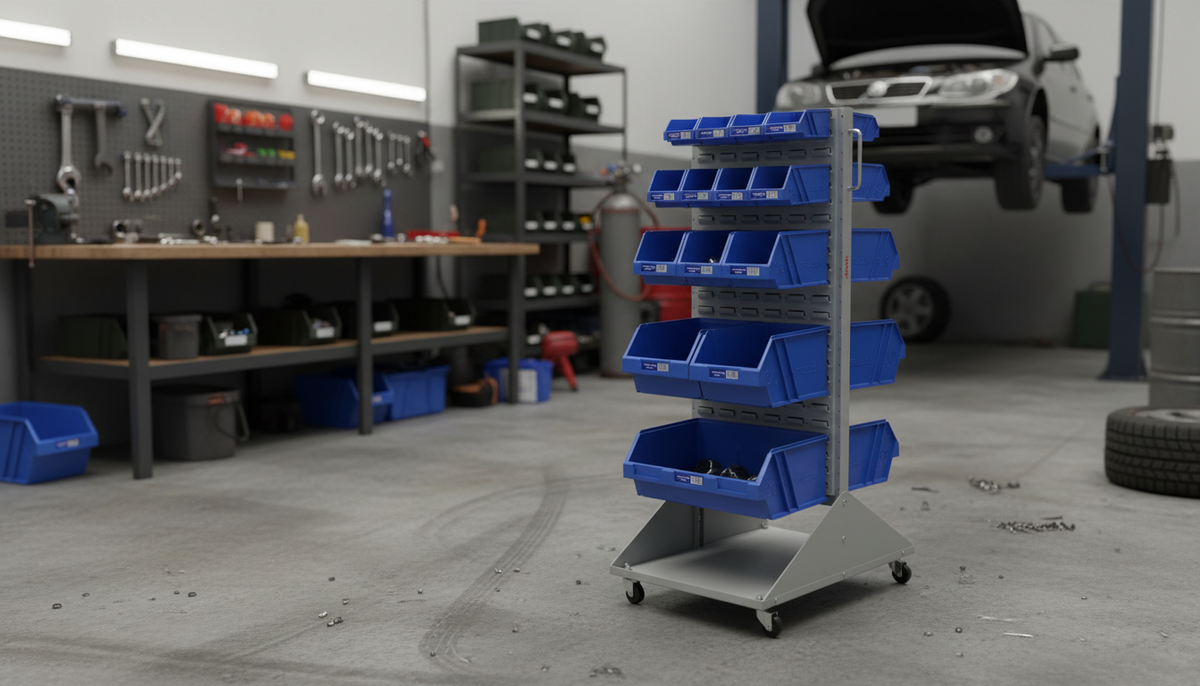
High Density Tool and Bucket Trolley
ReadyRack’s High Density Tool and Bucket Trolley is built specifically for optimising efficiency in warehouse and workshop environments, keeping tools and consumables together and mobile. It’s designed as a practical middle ground between a fixed tool cabinet and carrying tools by hand across a site, useful anywhere staff are regularly walking tools from a central store to where the work actually happens.
Site Box Trolley Cabinet
For a heavier-duty option, ReadyRack’s Site Box Trolley Cabinet is a lockable trolley with multiple shelf levels, suited to onsite storage where security matters as much as mobility. It’s available in small and large sizes depending on how much you need to move at once, and the lockable design makes it a better fit than an open trolley when tools are left unattended on a job site overnight.
Beyond trolleys: organising tool storage generally
Not every tool needs to move. Some are better mounted where they’re always visible and always in reach, which frees up trolley space for what actually needs to be mobile. ReadyRack’s tool board and louvre board range, along with individual tool holders, gives you a wall-mounted option for tools that live in one spot.
A sensible split for most workshops and warehouses:
- Frequently moved tools and consumables → trolley
- Fixed-position hand tools → wall-mounted tool board with holders
- Secure onsite storage → site box trolley cabinet
Getting this split right matters more than the trolley itself. A trolley overloaded with tools that never actually leave the workshop is just an expensive, awkward-to-move cabinet. The trolley should carry what genuinely moves; everything else is better off fixed.
Matching the trolley to the site
A single workshop with one main bench has different needs to a warehouse where staff are moving between zones all day. For a single-site workshop, one general-purpose trolley is usually enough. For a larger warehouse or a site with multiple work zones, it’s often more efficient to have a trolley stationed at each zone rather than one trolley being wheeled the length of the building repeatedly.
Keeping a trolley in good working order
A trolley gets more daily wear than most other tool storage on site, so a few basic habits go a long way:
- Check castors regularly. Grit and debris build up in wheel housings fast on a workshop or warehouse floor, and a seized castor is usually the first thing to go wrong.
- Don’t overload one side. An unevenly loaded trolley is harder to steer and more likely to tip, particularly on ramps or uneven concrete.
- Clean shelves and drawers periodically. Metal shavings, dust and spilled fasteners are easy to lose track of in a trolley that’s moving between areas all day.
- Store it somewhere sensible when not in use. A trolley left blocking an aisle or doorway becomes a hazard as much as a convenience.
Which trolley suits your site?
| If you need… | Consider… |
|---|---|
| General mobile tool and bucket storage | High Density Tool and Bucket Trolley |
| Lockable, heavier-duty onsite storage | Site Box Trolley Cabinet |
| Fixed, always-visible tool storage | Tool Board / Louvre Board with Tool Holders |
Frequently asked questions
Is a tool trolley the same as toolbox tool boxes?
Not exactly. “Toolbox tool boxes” is usually how people search when they’re comparing several toolbox options side by side. A tool trolley is a specific type: a wheeled unit built for moving tools and buckets around a site, rather than a single fixed toolbox.
How much weight can a tool trolley carry?
This varies by model, so check the load rating on the individual product listing before loading up. As a general rule, keep heavier items on the lower shelves to keep the trolley stable while it’s moving.
Are tool trolleys lockable?
Some are. ReadyRack’s Site Box Trolley Cabinet is specifically built as a lockable option, which suits sites where tools are left unattended between shifts or overnight on a job site.
Can a tool trolley replace fixed tool storage entirely?
Generally no. Trolleys are best for tools that genuinely move through the day. Tools that stay in one spot are usually better served by a wall-mounted board or a fixed cabinet, which keeps the trolley itself lighter and easier to manoeuvre.
Next step
Browse ReadyRack’s Trolley Carts collection to compare options, or get in touch if you’re outfitting a whole site and want advice on the right mix of mobile and fixed storage.